
Setting the Scene
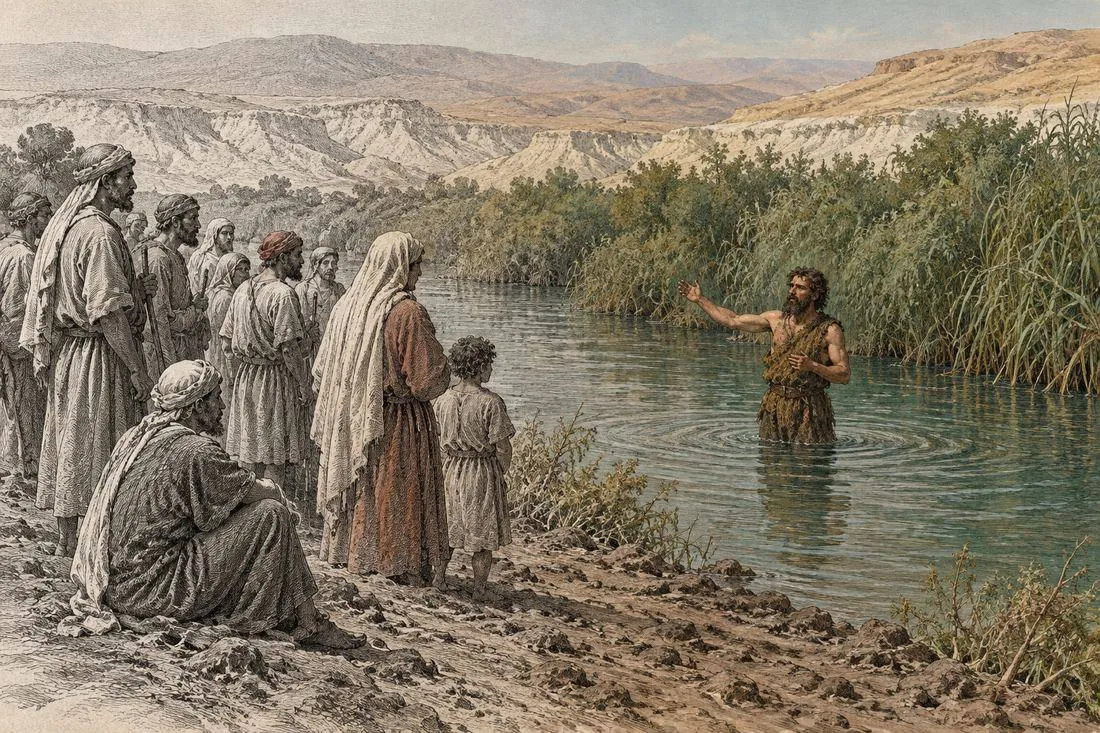
Picture the Jordan valley, somewhere around AD 28 to 30; nobody can fix the year more closely. Imagine the heat of the rift, far below the level of the sea, the light hard on the water and the smell of mud and reed where the bank is churned by feet. At Bethany across the Jordan, a man in a garment of camel's hair stands in the river. The current slaps at his waist, people murmur as they wait their turn, and there is a splash as one more goes under.
Picture a coin passing between two hands on the bank, stamped with the face of Tiberius. Pilate governs Judea, and Herod Antipas rules Galilee and Perea, the land east of the river. Yet the people are waiting, Luke tells us, wondering whether this baptiser might be the Christ. Priests and Levites have come down from Jerusalem to ask him to his face, and he has told them he is not. He is only a voice, he says; someone they do not know already stands among them.
Yesterday he pointed that man out. Now the baptiser stands with two of his own disciples, and someone is walking by. Watch John's eyes. They leave the crowd and follow the man along the bank, and his lips begin to move.
Open: Preview Question
Young adultsThink of a café, a band or a course you only tried because a friend you trusted took you along. Why did their word count for more than any advert online?
AdultsWhen you started a new job or moved to a new church, who made the first introductions for you, and what difference did it make?
Key Reading
John 1:35–42 (read John 1:29 first)
Key Verse
He first found his own brother Simon and said to him, “We have found the Messiah” (which means Christ). He brought him to Jesus. Jesus looked at him and said, “You are Simon the son of John. You shall be called Cephas” (which means Peter).
Complementary Readings
Matthew 10:2; Mark 3:18; Luke 6:14
See it: The Talk
Let's begin not with a man, but with a moment. Two men are standing beside John the Baptist at the Jordan when Jesus walks past, and John looks at him and says, “Behold, the Lamb of God!” (John 1:36). The day before, he had said more: “Behold, the Lamb of God, who takes away the sin of the world!” (John 1:29). In Israel lambs were among the animals offered to God for sin (Leviticus 4:32), and the Passover lamb marked God's rescue from Egypt, so John is telling his hearers that Jesus is the offering God provides to take sin away. He is also pointing his own disciples away from himself, and they go.
Picture a still pond and a stone dropping into it. The stone is Jesus himself, and nothing that follows has any worth without him. Yet rings move outward from where it falls, and one of the first belongs to a man John's Gospel introduces with a label: “Andrew, Simon Peter’s brother” (John 1:40). Most of us carry a label we never chose: someone's daughter, someone's older brother, the one from that family. Andrew carries his through the Gospels. John uses it again in John 6:8, and Matthew lists him straight after Simon as his brother (Matthew 10:2). The label is kind enough, but it always places Andrew beside someone better known. This series asks what Jesus made of each disciple beyond the label, and Andrew's first answer comes here. His story starts with receiving. Someone told him who Jesus is, and the news was that Jesus is the Lamb who deals with sin.
The two disciples follow, and Jesus turns and asks them, “What are you seeking?” (John 1:38). In John's Gospel these are the first words Jesus speaks, and they are a question about what they want. They answer: “Rabbi” (which means Teacher), “where are you staying?” (John 1:38). The verb for staying is the Greek menō, the ordinary word for lodging somewhere. The Gospel has just used it of the Spirit coming down and remaining on Jesus (1:32–33), and will use it again when Jesus tells his disciples to abide in him (John 15). In this sentence, though, it simply means where Jesus is living, and their question is probably a polite way of asking for time with him.
Jesus answers, “Come and you will see.” (John 1:39). He gives them no lecture by the roadside, only an invitation to be where he is. The Gospel then tells us “they stayed with him that day, for it was about the tenth hour” (John 1:39). The writer remembers the hour, but he does not tell us what was said or how long they stayed, and we should not fill the gap. What we know about that afternoon, we learn from what Andrew does next.
“He first found his own brother Simon” (John 1:41). Andrew went first to his own family, and the order is worth noticing, because what we do first after meeting someone often shows what the meeting meant to us. When he finds Simon, he tells him who Jesus is: “We have found the Messiah” (which means Christ) (John 1:41). Messiah is the Hebrew title for the anointed one, the king God had promised, and the Gospel writer gives its Greek equivalent, Christ, for his readers. Notice the ‘we’: Andrew speaks of something he and his companion discovered together. He is also passing on what he received. John the Baptist told him Jesus is the Lamb of God; Andrew now tells his brother that Jesus is the Messiah. His witness has content. It is a claim about Jesus before it is a story about Andrew.
Then comes the simplest sentence in the passage: “He brought him to Jesus.” (John 1:42). There is a difference between a signpost and a guide. A signpost points the way but stays where it is; a guide walks the road with you and says, ‘Let's go together.’ Andrew didn't hand Peter a spiritual map; he gave him his hand. We should not push that picture into a rule that words are never enough, because Andrew spoke first and then went with his brother. Words and company belong together. The words tell Simon who Jesus is, and the company gets Simon into the room.
And there Andrew's part ends. Jesus looked at him and said, “You are Simon the son of John. You shall be called Cephas” (John 1:42). Jesus already knows who Simon is, and he tells him who he will be. Cephas is Aramaic for rock, and Peter is its Greek equivalent. Andrew could bring Simon to Jesus, but he could not give him that name. Only Jesus can do that, and the rest of the Gospel shows that Simon did not become a rock overnight: he denies Jesus three times (John 18) before Jesus restores him (John 21). The new name is Jesus' promise about what he will make of Simon, and Jesus keeps it.
This is where the passage meets us. Many of us came to faith because someone pointed us to Jesus, and some because someone went with us. Our part is real: we tell someone plainly who Jesus is, and we go with them. But our part is limited, and that is good news. We cannot give anyone a new name or a new heart, and we do not have to. Paul says that one person plants and another waters, but God gives the growth (1 Corinthians 3:6). So if someone says no, the story has not ended. Keep loving them and stay ready to go with them if the day comes; the result was never in your hands.
Andrew is still “Simon Peter’s brother” at the end of this passage, but we have seen what he did. He heard who Jesus is, he stayed with him, and he brought his brother. The ripple keeps moving outward because the stone at its centre is the Lamb of God, and that is as true in your town as it was at the Jordan.
Cultural Context
Following a teacher
In Jesus' day a teacher's disciples learned by being with him: listening, asking questions and watching how he lived. John the Baptist had disciples, and so did the Pharisees (Mark 2:18). The Greek word is mathētēs, a learner; the Hebrew equivalent is talmid, from lamad, to learn. So when Andrew and his companion call Jesus “Rabbi” and ask where he is staying, they are asking for the time a learner needs with a teacher. Here it begins with what was probably one afternoon. Leaving the fishing nets comes later (Mark 1:16–18).
Word Study
Messiah (Μεσσίας: Messias)
Andrew's word in John 1:41 is a Greek spelling of the Hebrew מָשִׁיחַ (mashiach), "anointed one", from the verb mashach, to anoint with oil, and the Gospel writer gives its Greek equivalent, Χριστός (Christos). The Old Testament uses it of anointed priests (Leviticus 4:3) and above all of Israel's king (1 Samuel 24:6; Psalm 2:2). Hopes about a coming anointed one varied in Jesus' day, so Andrew's words carry no single fixed political plan; in his sentence it is a claim that Jesus is the king God had promised.
Lamb (ἀμνός: amnos)
John the Baptist uses this word in John 1:29 and 1:36, where the Lamb is the one who takes away the sin of the world. Behind the image stands the Hebrew שֶׂה (seh), one of the flock, used of the Passover lamb (Exodus 12:3–5) and of the lamb led to slaughter in Isaiah 53:7, while the daily offerings use כֶּבֶשׂ (kebes) (Exodus 29:38–39). John the Baptist does not say which lamb he means, so probably more than one is in view, though John's Gospel later links Jesus' death with Passover (John 19:14, 36).
Cephas (Κηφᾶς: Kēphas)
Jesus gives Simon this name in John 1:42, and the Gospel translates it as Πέτρος (Petros), Peter. It comes from the Aramaic כֵּיפָא (kepha), "rock" or "stone", in the everyday language of many Jews in Galilee and Judea, and Paul still calls him Cephas (1 Corinthians 15:5). Jesus gives the name before Simon has done anything to earn it, so it is a promise from Jesus rather than a clue to Simon's personality.
Historical Note
John the Baptist outside the Bible
Andrew's first teacher is known beyond the Gospels. The Jewish historian Josephus, writing in the 90s AD (Jewish Antiquities 18.116–119), remembers John, called the Baptist, as a good man who urged his fellow Jews to live justly with one another and devoutly towards God, and to come to baptism. Josephus says Herod Antipas feared John's hold on the crowds, imprisoned him in the fortress of Machaerus and put him to death. So the man who pointed Andrew to Jesus was a public figure whose word carried weight, and he used that weight to send his own disciples away from himself.
Talk it through: Discussion Questions
1Level 1: Observation
Read verses 35 to 42 again. What does Andrew do after his day with Jesus, and what does only Jesus do?
2Level 2: Interpretation
A signpost points the way and stays put; a guide walks the road with you. Andrew both spoke and went with his brother. Why do his words and his going both matter, and why does the passage end with Jesus speaking, not Andrew?
3Level 3: Application
Who was an Andrew for you? (Answer silently if you prefer.) Without naming anyone aloud, think of one person who might need a guide more than a signpost. What is one small step you could take this week to walk with them, and how would you stay their friend if they said no?
Live it: Modern Connection

Picture a kitchen in your town, late on a Sunday night. The kettle is working up to the boil, the window is black, and a phone on the counter keeps lighting up with things nobody asked for. Ciara has just come in from church, where the speaker read John 1 and stopped on one line: the Lamb of God who takes away the sin of the world. Her brother Daniel is at the table, half-watching a match on his laptop.
She could send him the link to the talk. It is the modern way of pointing, like dropping a pin on a map. Instead she makes two mugs of tea, sits down across from him and tells him plainly who she believes Jesus is. Then she says, ‘Come with me on Thursday. I'll pick you up.’ He might say no. She knows that, and she will still be his sister on Friday. What happens if he comes is not hers to do.
Take-Away Challenge
Young adultsThink of one flatmate, course-mate or teammate who has asked you anything about faith. This week, make time to be with them over a coffee, a walk or a meal. Listen properly, and if the moment is right, tell them simply who Jesus is to you, or offer to read John 1:35–42 together. If they say no, keep the friendship exactly as it was; a no this week is not the end of the story.
AdultsThink of one colleague, neighbour or family member, perhaps one of your own children, who is near the edge of faith. This week, offer one concrete thing: a meal where you listen first, reading this passage together, or going with them to church and sitting beside them. If they decline, keep loving them and leave the outcome with Jesus.
Prayer Focus
Father, thank you for sending your Son, the Lamb of God who takes away the sin of the world. Thank you for the Andrews in our lives, the people who told us who Jesus is and did not only give us directions but went with us to him. Lord Jesus, keep us close to you, so that when we speak about you we have something true to say. Give us the courage to find someone we love and bring them to you, and when they say no, the trust to leave with you what only you can do. Thank you that you know each of us by name. Amen.
Character Gallery
Andrew: The Connector. Three times John's Gospel lets us see Andrew, and each time he is bringing someone to Jesus' notice: his brother at the Jordan, a boy with five barley loaves by the Sea of Galilee, and some Greeks at the feast who wanted to see Jesus. John describes no temperament, only this habit. Today Andrew might be Brian, sixty-one, who notices the young man from the new flats standing alone at the back of church. Brian walks over and asks his name. He does not hand him a leaflet; he sits beside him and finds the reading for him. Afterwards he introduces him to the minister. Then he steps back, because what happens next is between that young man and Jesus.
Go deeper
John's Gospel places these events at Bethany across the Jordan (John 1:28). Andrew and Simon came from Bethsaida (1:44), and Mark tells us they were fishermen; his account of their call by the Sea of Galilee (Mark 1:16–18) probably comes after this first meeting. The “tenth hour” is usually taken as about four in the afternoon, counting from sunrise. The Session 1 Four Fish study (longer leader's notes) goes further.
Further reading: John 1:1–18; Exodus 12:1–13; Isaiah 53:4–7; John 6:5–9; 1 Corinthians 3:5–7.
That was Session 1.
Sessions 2 to 4 follow Andrew to the hillside, the temple and the mountain. They are open to groups in the preview, with the app, the map, the TV mode and the printed guides.